A patient’s experience is shaped by more than the time spent with one provider. It starts at check-in, continues with the medical assistant or nurse, and may involve referrals, behavioral health support, lactation services, or collaboration between providers. Each person plays a role in helping the visit feel organized, welcoming, and responsive.
At WFMC Health, many providers describe the clinic’s team and work environment as an important part of why they value working here. Their comments also point to something patients may not always see: when healthcare professionals feel supported, connected, and able to rely on one another, care can feel more personal and coordinated.
A Positive Experience From Start to Finish
Emily Nebzydoski, MD, sees a direct connection between how WFMC Health supports its staff and how patients experience their care.
“I think they care a lot about their patients, but they care about their staff a lot too,” she said. “I think that makes for a more pleasant experience from the start to the finish of the visit.”
She added, “Whether it’s with the front desk checking you in, the MA rooming you, or us as providers, we’re generally happy people here.”
A supportive work environment doesn’t mean that every day is easy. Healthcare can be demanding, and patient needs can be complex. But when staff members feel respected and have the resources and relationships they need, they are better positioned to remain present and helpful throughout the patient’s visit.
Collaboration Across Different Roles
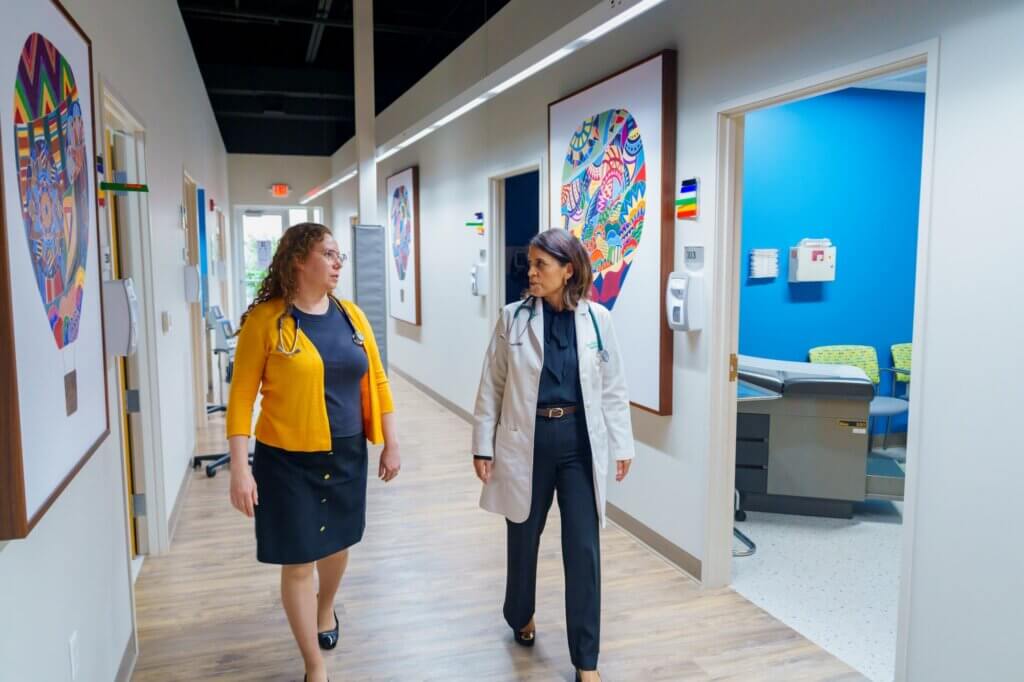
Patients typically see one provider during an appointment, but care usually involves many people working together. At WFMC Health, providers can consult with colleagues across different practice areas and departments. That collaboration allows questions to be addressed more efficiently and helps the team consider different parts of a patient’s needs.
Dr. Emily appreciates having colleagues nearby when she wants another perspective.
“We have some really great family medicine providers here, [and] some midwives as well,” she said, “and we have lactation, which is great.”
She explained that the team’s accessibility makes it easy to ask a coworker to look at a concern, consult with the lactation specialist, or communicate with staff who coordinate referrals.
“It’s pretty cohesive and everyone works really well together, no matter like their specialty or what they do,” she shared.
For patients, that cohesiveness means their provider isn’t working in isolation. When another perspective or service could be helpful, the team can communicate and work together to provide the best possible care.
Integrated Care Requires a Connected Team
Teamwork within healthcare is especially important in an integrated care setting.
Miguel Gonzalez, LPC, provides behavioral health support within WFMC Health’s primary care clinic. His work involves collaborating not only with other behavioral health clinicians, but also with medical providers, nurses, and medical assistants.
This kind of communication can help patients receive support without having to coordinate every part of their care alone. If a behavioral health concern comes up during a medical visit, a behavioral health provider may be able to join the conversation. If a provider has a question about another area of care, another colleague may be available to offer guidance. Instead of waiting for a referral, the patient gets to stay at the clinic while the team brings together different skills and perspectives around them.
“The ability to go and talk to a colleague about a patient to make sure we’re providing the best services [and] have that support is really nice,” he shared.
Support Helps Providers Through Difficult Work
Healthcare professionals also rely on one another during emotionally difficult days. Behavioral health work, for example, can involve counseling through painful and difficult experiences. Having trusted colleagues creates space for clinicians to consult, reflect, and find support as they continue caring for patients.
“Here in the clinic, we have really good relationships with each other,” Daisy Barrios-Hani, LCSW, shared. “We can socialize, we can support each other, and we can talk about things whenever any support is needed.”
That support is incredibly important because providers are people too. Having a connected team helps them process difficult work and return to patient care with greater steadiness and perspective.
Reliable Coworkers Make a Difference
Amy Whitsa, PA-C, was still relatively new to WFMC Health at the time of her interview, but she had already noticed the strength of the team.
“I really enjoy our whole team here,” she said. “I’m pretty new to WFMC, but I already know what a fantastic team we have here.”
“That makes a huge difference when you have coworkers you can rely on,” she added.
Reliability behind the scenes can translate into consistency for patients. Team members can help answer questions, manage follow-up needs, and step in when another person needs support. No single provider can meet every need alone. Strong care depends on people knowing when to collaborate and trusting that their coworkers will respond.
A Supportive Environment Strengthens the Mission
Nitish Jagpal, MD, also connects his experience at WFMC Health with the team around him.
“Since I’ve been working here, I’ve been blessed to have a good team around me and good supportive environment,” he said.
For Dr. Jagpal, that support exists within a clinic that puts patients first and welcomes people from across the community.
A clear mission can also help unify staff across different roles. When team members understand who they are serving and why the work matters, collaboration becomes part of how the organization carries out its values.
“I also really value the team that I’m a part of here,” Devin Salazar, MSN, CNM, shared. “It’s by far the most diverse health care team I’ve been a part of since being in practice.”
She sees that diversity as reflecting the community WFMC Health serves.
“We serve a racially and socioeconomically diverse patient population,” she explained. “I think that’s really reflected in the team here, which I really appreciate.”
A team that reflects its community can bring a wider range of experiences, language skills, and perspectives to patient care.
Building Something Together
WFMC Health is a place where team members care about the clinic and its future.
“I think we have a great group of people working here who really care about this place,” Oleg Balter, MD, shared.
That sense of shared investment can encourage providers to contribute ideas, expand services, and work together to improve how care is delivered.
It can also create stability. Patients benefit when the people caring for them are invested in the organization and interested in building something foundational for the community.
Teamwork Patients Can Feel
Patients might not see every conversation that happens behind the scenes. They might not know when one provider consults another, when a nurse helps coordinate follow-up, or when coworkers support each other after a difficult day. But they can usually feel the results.
They experience it when communication is clear throughout their appointment, when someone knows where to direct a question, or when different parts of the clinic work together instead of feeling disconnected. A supported care team helps create an environment where providers can focus on patients, ask for help when needed, and draw on the strengths of their colleagues.
At WFMC Health, compassionate care is a shared effort. It is built not only through individual expertise, but through a team that listens to one another, supports one another, and works together around the needs of every patient.
